
A plain-language breakdown for architects, developers, and owners navigating the NFPA 72 National Fire Alarm and Signaling Code, issued and monitored by the National Fire Protection Association (NFPA), which is available for purchase through NFPA.org.
About this series: Decoded is written for the people who build, own, and occupy buildings. Each post takes a single fire or building safety reference document, strips away the jargon, and explains what it actually requires, why, and what it means for your project.
What is NFPA 72?
NFPA 72 is the National Fire Alarm and Signaling Code, published by the National Fire Protection Association (NFPA). It sets the requirements for how a building’s fire alarm and signaling systems are designed, installed, and maintained. The current version is the 2025 edition, though the applicable edition depends on what your local jurisdiction has adopted.
A building code (typically the International Building Code) tells you whether a fire alarm system is required. NFPA 72 specifies how the system must perform and provides the exact rules governing the detectors and notification devices that warn people and trigger a building’s response when something goes wrong.
Key distinction to understand NFPA 72:
- The building code decides whether you need a fire alarm system.
- NFPA 72 governs how it gets built and verified.
- Both apply to most commercial building projects, and they reference one another.
Why does NFPA 72 matter?
For most teams, the fire alarm system is the building system that most directly affects whether a project opens on time. Fire alarm work is usually one of the last systems completed and one of the first verified before a building can open, so it must be part of the planning conversations from the earliest stage. The system must be installed and fully tested before the final occupancy inspection, and that acceptance test is often witnessed by the Authority Having Jurisdiction (AHJ). A clean result clears the way to occupancy; a failed one can stall it.
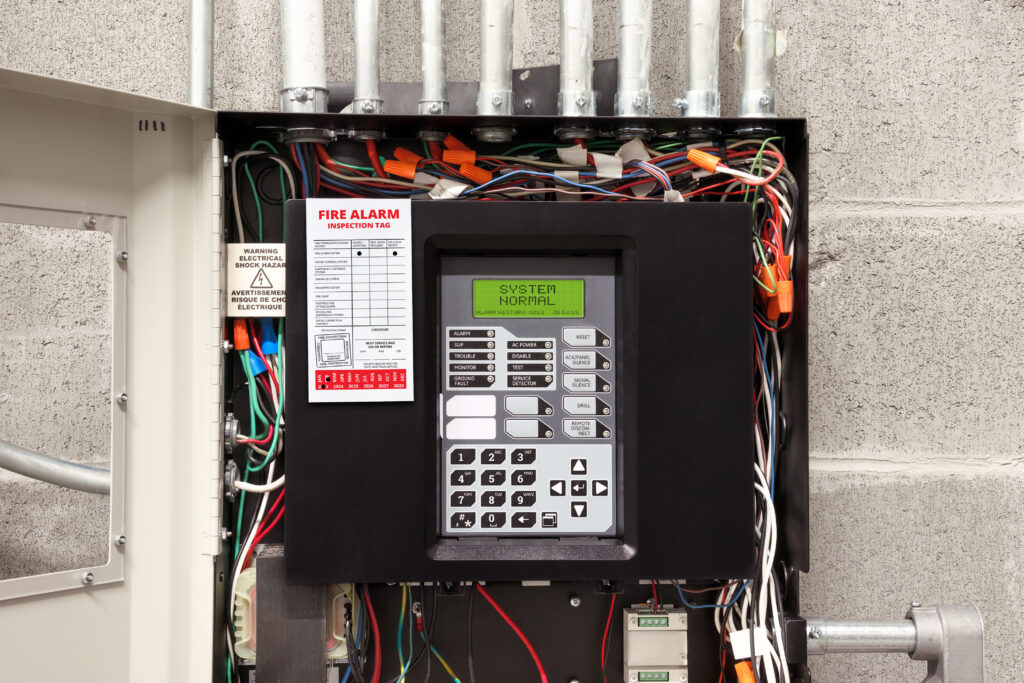
The stakes are high because the fire alarm panel rarely acts alone. It often serves as the building’s hub, the brain that tells other systems what to do when an alarm activates. Depending on the structure, that can include:
- Recalling elevators to a safe floor
- Shutting down or repositioning HVAC equipment
- Releasing magnetically held doors
- Activating smoke control
Because the panel coordinates so many other systems, a problem discovered late doesn’t stay contained to the fire alarm scope. Non-compliance can trigger a ripple of rework across architectural, MEP, and life safety systems, and that rework lands at the worst possible time, right before the opening date. That is why understanding what NFPA 72 requires, and planning around it early, pays off.
What’s covered in NFPA 72?
This standard isn’t limited to just smoke detectors and pull stations. While there are many items on the punch list that are simple to check off, fire alarm coverage planning and installation aren’t siloed tasks.
NFPA 72 governs:
- Fire detection, including smoke, heat, and thermal imaging detectors.
- Notification, from horns and strobes to speakers and voice evacuation.
- Emergency communication systems, including mass notification used for non-fire emergencies.
- Gas leak detection, including newer acoustic (ultrasonic) leak detection technology
- The control panel and how it is monitored by a supervising station.
- Circuits and pathways, and whether they stay intact long enough during a fire to do their job.
- Documentation, from shop drawings through the final record of completion.
- Inspection, testing, and maintenance once the system is in service.
How does compliance with NFPA 72 affect construction plans?
Because the fire alarm system sits on the critical path to opening, the design decisions you make early have an outsized effect on the schedule. A few reasons it deserves attention from the start:
- Devices reach nearly every room and tie into other systems, so the layout has to be coordinated with the work of several other trades rather than assumed. Those interfaces (elevator recall, HVAC shutdown, door release, smoke control) are best worked out on paper, not discovered at inspection.
- Constructability matters as much as code compliance. A layout that checks every box on the drawings still has to be practical to install and route in the field.
- The edition in force varies by jurisdiction, so designing to the code edition your jurisdiction has adopted keeps the design from unraveling at AHJ review.
- Phased and occupied-building work needs a plan, so life safety stays intact while the new system goes in.
Getting these connections right with the architectural, MEP, and life safety teams is a big part of what makes a building perform safely as a whole, which is exactly why it belongs in the conversation early.
What happens during fire alarm acceptance testing?
Before a new fire alarm system is placed in service, NFPA 72 requires a documented acceptance test. Every device and function must be verified against the approved design, and the results recorded on a formal record of completion. On most projects, the AHJ witnesses this test.
This is where the system proves it performs as designed. The test confirms things like:
- Each strobe and speaker is placed and performing correctly, with notification coverage that meets placement and audibility requirements throughout the space.
- Every circuit reports properly to the panel.
- The interfaces with other systems activate as intended.
Because the test sits close to the opening date, it’s critical to arrive prepared. Many teams run a pre-test, sometimes called a mock inspection, before the official witnessed test, which confirms that the system is ready and increases the likelihood of the formal review going smoothly.
In some jurisdictions, such as New York City, inspection protocols are especially demanding, which makes preparation even more valuable.
Fire alarm maintenance requirements according to NFPA 72
NFPA 72 also sets ongoing inspection, testing, and maintenance (ITM) requirements that continue for the life of the fire alarm system. While a qualified technician performs the device tests on a set schedule, the owner remains responsible for ensuring that testing occurs and that records are kept on file.
ITM exists so the system stays compliant and ready to perform long after the ribbon is cut. Early planning for this requirement will keep the building in good standing and the system performing the way it was designed to.
Related Reading: Can Third-Party Fire Protection System Reviews Help My Project Team Avoid Construction-Phase Conflicts?
When should you bring in fire alarm expertise?
Fire alarm expertise adds the most value early, before design decisions harden and coordination gaps turn into rework. Consider bringing on a fire alarm consultant when:
- Your design team wants help interpreting the code or preparing the fire alarm design itself.
- The project is a renovation or upgrade where an existing system must tie into new work.
- Construction is phased or the building is occupied, so life safety must hold throughout.
- You are working toward a Certificate of Occupancy and want the inspection to go cleanly the first time.
- You want to pre-test the system and prepare for inspection, so the official review confirms a system that already performs as intended.
Takeaway: Coordinate building systems around a pre-tested fire alarm system
The fire alarm system is the building system that most directly affects whether a project opens on time and operates safely. To that end, it’s critical to understand what NFPA 72 requires and to plan around it early.
Questions about NFPA 72’s applicability to your specific building systems, or how to navigate the code?
About the Author
Steven Venditti, P.E. President | Sparc
Steven Venditti, P.E., has a Bachelor of Science and a Master of Engineering in Fire Protection Engineering from the University of Maryland. Mr. Venditti is a Professional Engineer (P.E.) licensed in multiple states. He has over 21 years of experience in fire protection engineering, including sprinkler and fire alarm system design, performance-based design of smoke control systems utilizing computer fire modeling, as well as fire investigations, code consulting, and interpretation. He has applied these skills to various facilities, such as office buildings, hotels, assembly spaces, and mixed-use complexes. Mr. Venditti has extensive expertise and knowledge of various codes and design standards, including NFPA, IBC, and local building codes.